Artificial intelligence has progressed rapidly. From early automation to generative content tools, we’re now entering a new phase: Agentic AI — systems that not only generate responses but also act toward business outcomes.
If you work in marketing, sales, customer success, or revenue operations, agentic AI is not an abstract concept. It is beginning to reshape how go-to-market (GTM) teams work inside platforms like HubSpot.
In this post, we’ll cover:
- What agentic AI actually means
- How it differs from generative AI
- Why it’s relevant to GTM teams
- How HubSpot’s Breeze AI suite exemplifies agentic principles
- The role of the Agentic Customer Platform in HubSpot’s vision
- How responsible AI fits into the picture
What Is Agentic AI?
Agentic AI refers to artificial intelligence systems that go beyond simple response generation to plan, act, and execute tasks within workflows.
Standard generative AI — for example, a large language model (LLM) — can produce text based on prompts. Agentic AI, by contrast, can:
- Understand a goal or objective
- Break it into steps
- Retrieve relevant data from systems
- Execute actions across tools and workflows
- Adjust based on context and outcomes
You can think of it as not only “answering a question” but “doing work on behalf of a user” in a structured context.
This shift from static output to dynamic action makes agentic AI especially powerful for GTM functions such as lead generation, sales execution, and customer support.
Agentic AI vs. Generative AI
It helps to frame agentic AI in contrast to traditional generative AI:
Generative AI:
- Produces text or content based on a prompt
- Does not inherently interact with external systems
- Does not take actions on workflows
Agentic AI:
- Retrieves contextual information from live systems
- Orchestrates steps to complete a business task
- Can perform actions involving data and tools
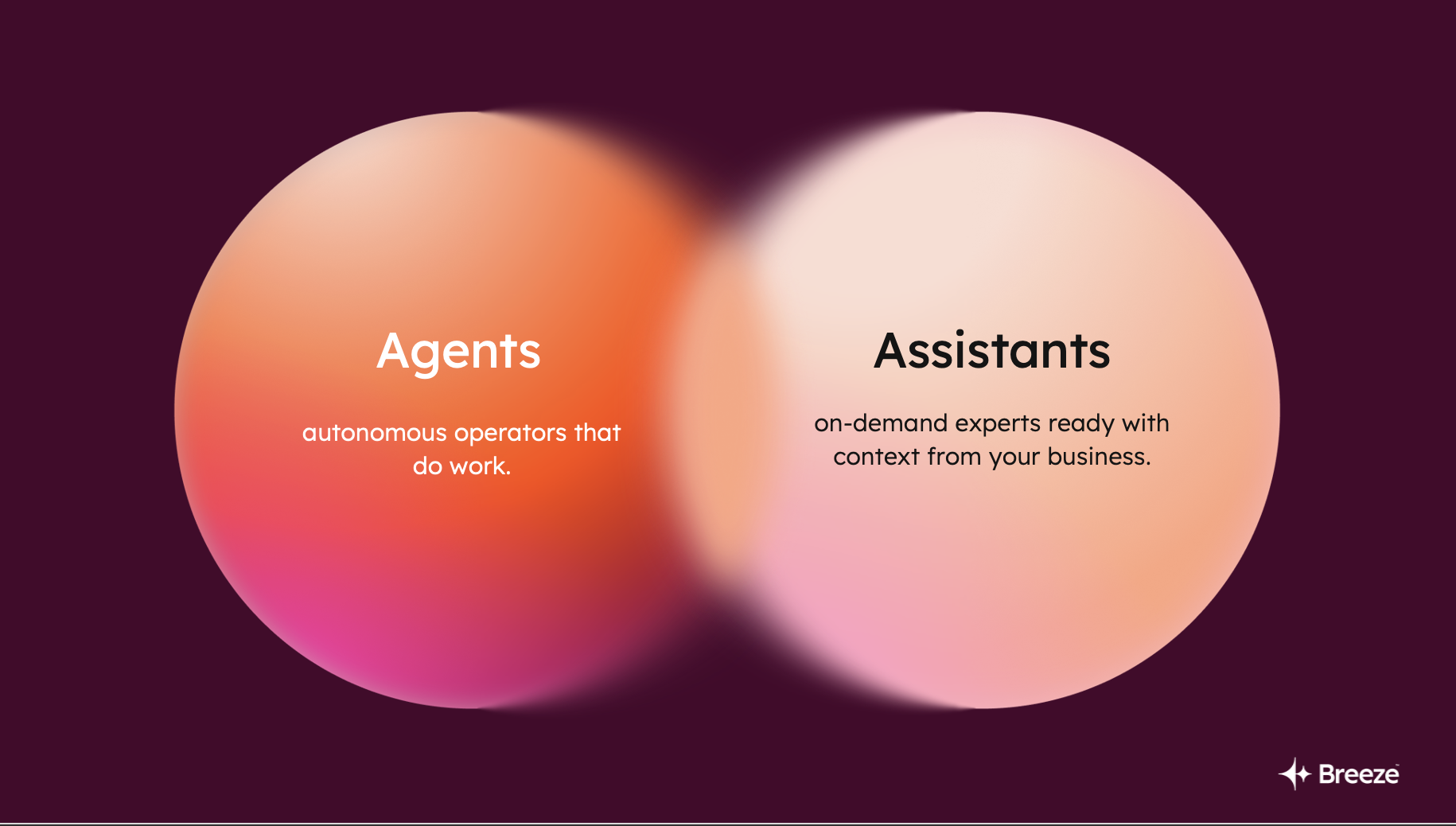
Source: HubSpot Breeze AI Agents vs Assistants
In the GTM context, agentic AI can, for example, identify leads, qualify them, draft personalised outreach, and update CRM records, whereas a generative model might only write an outreach email. This shift matters because GTM work is inherently workflow-driven, not just text-centric.
Why Context Matters More Than“Being AI-First”
Most organisations have context scattered across CRMs, inboxes, call notes, Slack threads, docs, and people’s heads. When AI can’t access that context, it produces generic outputs that look good but don’t reliably drive results.
HubSpot’s view (articulated by Yamini Rangan) is that the missing ingredient is context, the right information, at the right time, with the ability to act on it.
This is why “AI-first” positioning tends to fall short in practice. The winning approach is context-first: put customer and business context at the centre so agents can operate like informed teammates, not “smart interns on day one”.
Why Agentic AI Matters for GTM Teams
Agentic AI maps directly to the reality of GTM work:
- Marketing: campaign execution, segmentation, content operations, lead qualification
- Sales: prospecting, prioritisation, personalisation, follow-up, pipeline hygiene
- Service/CS: faster resolution, deflection, better handoffs, proactive account signals
- RevOps: governance, workflow orchestration, data quality, reporting consistency
When agents can access unified context, they can reduce manual coordination and help teams move from “busy work” to outcomes.
HubSpot’s Agentic Customer Platform
In early 2026, HubSpot introduced the concept of the Agentic Customer Platform, a context-first vision for AI inside CRM and GTM systems. In that framework, software doesn’t simply generate output; it uses complete customer context, history, interactions, signals, and system data to power AI agents and workflows that support marketing, sales, and service outcomes.
According to HubSpot leadership, the goal is to bridge the gap between AI output and business outcomes by ensuring AI has access to the context it needs to be genuinely useful.
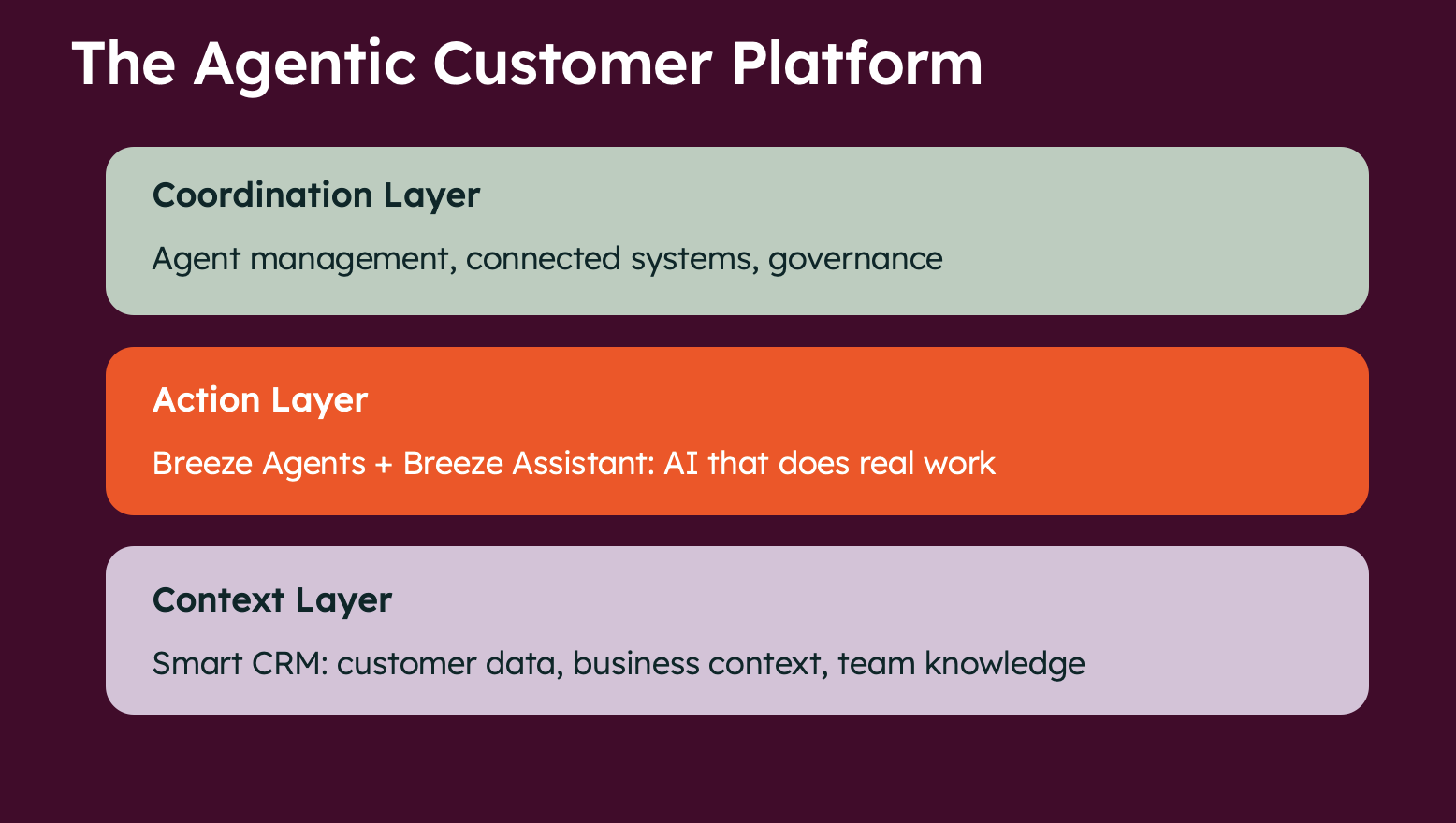
Source: HubSpot Agentic Customer Platform
This context-driven, agentic approach is foundational to HubSpot’s Breeze AI portfolio.
How HubSpot Reflects Agentic Principles
HubSpot’s Breeze AI ecosystem applies agentic principles in multiple ways, embedding AI context-aware capability into the tools that GTM teams use every day:
Breeze Assistant: Your AI Expert
The Breeze Assistant serves as HubSpot’s built-in AI expert, helping users with:
- Drafting content
- Summarising CRM records
- Answering context-aware questions
- Making CRM data more accessible
It operates within HubSpot, so AI suggestions are tied to real customer data.
Watch Breeze Assistant in Action ⬇️
Customer Agent: Structured AI for Customer Interactions
The Customer Agent goes beyond assistance. It can:
- Interact with customers using your knowledge base and CRM context
- Automate responses to common queries
- Support service-focused workflows
This is agentic behaviour because the agent retrieves internal data and acts in customer channels rather than just generating standalone text.
Watch a walkthrough of the Customer Agent Live from HubSpot:
Source: HubSpot Customer Agent Demo by Graham O'Connor at a Dublin HUG meet up
Prospecting Agent: AI in Sales Workflows
The Prospecting Agent focuses on sales execution:
- Identifying prospects
- Drafting personalised outreach
- Prioritising work
- Operating across contacts and pipeline
This represents agentic AI applied to sales workflows, AI that works with real CRM data and operational steps.
We have a webinar coming soon. Join the Dublin HUG Chapter to stay tuned!

Breeze Studio: Configuring Intelligent Behaviour
Breeze Studio enables teams to define how AI should behave within their portal. Instead of having AI that reacts only to prompts, Breeze Studio lets organisations:
- Build custom assistants
- Configure rules and context
- Align AI agents to specific GTM processes
This is key to tailoring agentic AI not just for tasks but for how work actually happens in your teams.
Watch: Getting Real Value from Breeze AI:
Source: Getting Real Value from Breeze AI HUG Webinar with Shay Redmond
Agentic AI and the Future of Go-to-Market
Agentic AI signifies a fundamental shift:
From generative outputs to workflow execution.
For GTM teams, that means:
- AI that understands process context
- AI that can act across systems
- AI that aligns across marketing, sales, and service
- AI that supports measurable business outcomes
This is why platforms that combine CRM, customer context, and agentic AI will be central to the future of revenue and customer experience.
Responsible and Trustworthy AI
As AI becomes more autonomous, trust and governance are essential. HubSpot has published a set of AI trust principles and policies emphasising:
- Data protection and privacy
- Transparency about how AI works
- User control over AI behaviour
- Secure and compliant implementation
You can explore HubSpot’s AI trust and safety approach here:
https://www.hubspot.com/products/artificial-intelligence/ai-trust
HubSpot applies these principles across Breeze AI and other embedded AI features to ensure that agentic AI operates within clear safety boundaries.
What Agentic AI Means for the Future of GTM
Agentic AI represents a shift:
From generating outputs → to driving outcomes.
For GTM teams, the practical implication is that the best AI won’t just be the most capable model. It will be the AI that can reliably operate within your real workflows, using your real context, with clear permissions, auditability, and control.
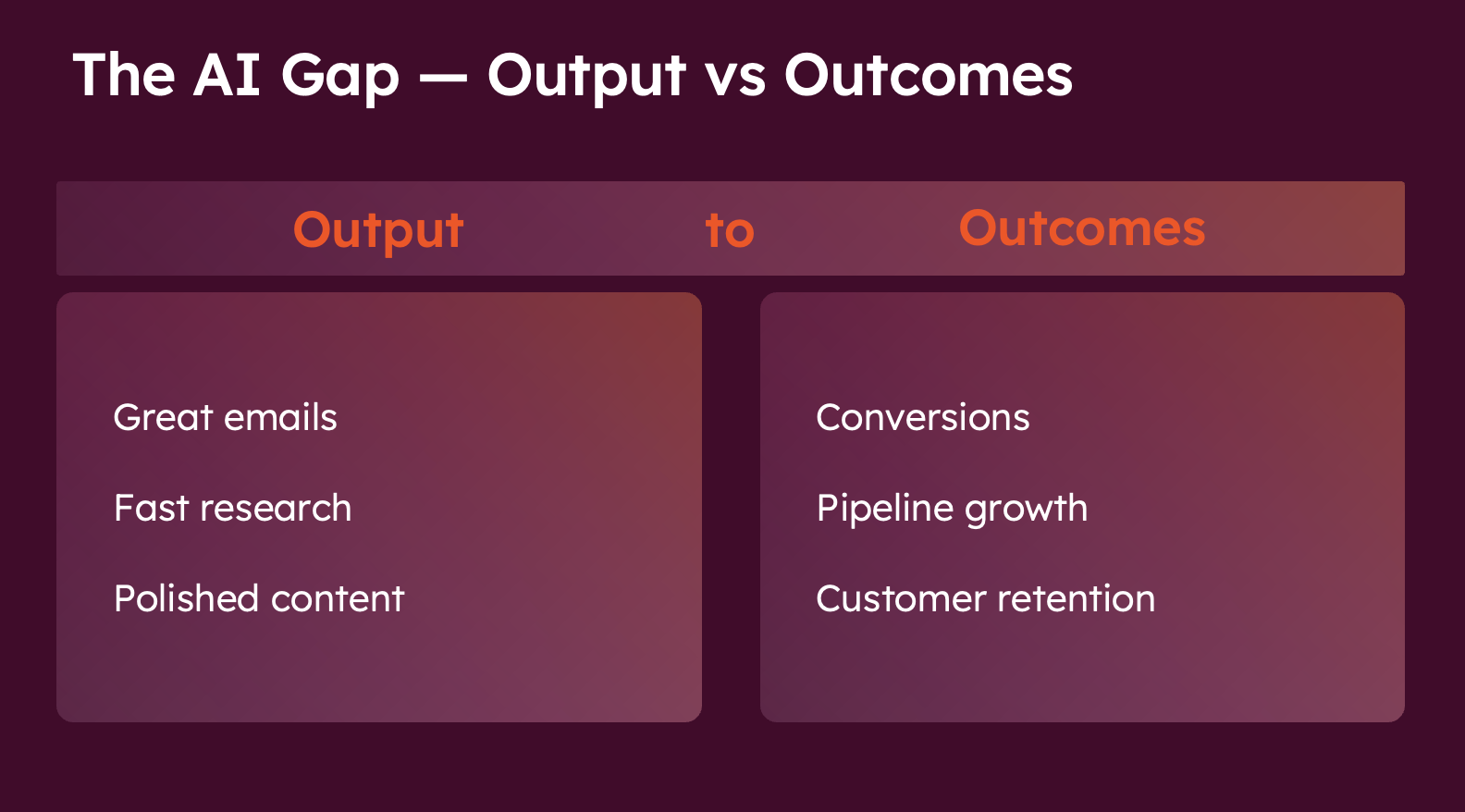
HubSpot’s Breeze AI ecosystem, from the Breeze Assistant to Customer and Prospecting Agents, and configured in Breeze Studio, demonstrates how agentic AI can be applied to real work.
Understanding how agentic AI works, and how it fits into your go-to-market stack, equips you to make smarter decisions, improve consistency, reduce manual effort, and unlock real value from your CRM and customer data.
Frequently Asked Questions About Agentic AI
What is agentic AI in simple terms?
Agentic AI refers to artificial intelligence systems that can take action toward a goal, rather than just generate responses. Instead of answering a prompt, agentic AI can plan steps, retrieve data, and execute tasks within workflows.
How is agentic AI different from generative AI?
Generative AI produces content based on prompts. Agentic AI combines generation with planning, data retrieval and execution. It operates inside processes rather than responding in isolation.
Why is agentic AI important for GTM teams?
Go-to-market teams rely on structured workflows across marketing, sales and customer success. Agentic AI can support these workflows by retrieving CRM data, executing tasks and reducing manual coordination between teams.
Why does context matter for AI agents?
Without context, AI is generic and inconsistent. With context, agents can behave like informed teammates and drive outcomes.
What is HubSpot’s Agentic Customer Platform?
HubSpot’s vision is a customer platform where unified context powers both humans and AI agents to improve marketing, sales, and service results.
Is Breeze AI in HubSpot agentic?
Elements of Breeze AI reflect agentic principles. The Customer Agent and Prospecting Agent execute structured workflows using CRM context. Breeze Studio allows teams to configure AI behaviour, and Breeze Assistant provides contextual support inside the platform.
Does agentic AI replace GTM teams?
No. Agentic AI supports execution and efficiency, but human oversight, strategy and decision-making remain essential. The goal is augmentation, not replacement.
Is agentic AI safe to use in CRM systems?
Safety depends on governance and platform design. HubSpot outlines its AI trust and safety principles at https://www.hubspot.com/products/artificial-intelligence/ai-trust, focusing on transparency, data protection and responsible AI usage.
Share your Thoughts or Ask Us Anything!