Fall Spotlight 2026 gives us a much clearer picture of where HubSpot is taking the platform.
Across 134 product updates, HubSpot is building around a few major shifts:
A CRM that captures more of what is happening automatically, a shared context layer that helps AI understand the business behind the data, assistants and agents that can take on more of the work, and a more open platform that can operate across the wider AI stack.
Some of the releases are immediately valuable. Others are more interesting because of what they tell us about where HubSpot is heading.
For existing HubSpot customers, these updates start to change how the CRM is maintained, how teams interact with it, how AI participates in business processes and how HubSpot connects with the tools people are already using.
After going through the Fall Spotlight announcements, these are the updates we think deserve the most attention, what they mean in practice, and where we would start.
The self-updating CRM could have a bigger impact than it sounds
One recurring CRM problem has always been painfully simple: it only knows what people remember to put into it.
A meeting happens, and the deal never gets updated. An important objection stays buried in an email. The next step lives in someone's notes. Marketing, Sales and Service gradually end up with slightly different versions of what is happening with the same customer.
That becomes an even bigger problem when AI is expected to use CRM data to recommend or take action.
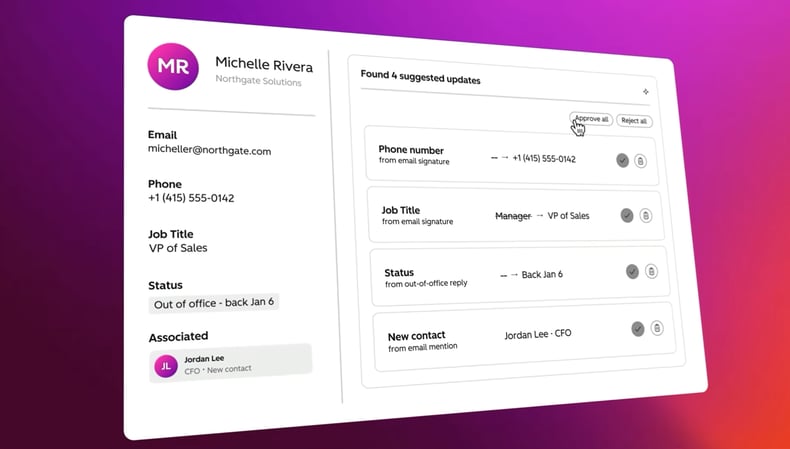
HubSpot's self-updating CRM is designed to capture more information from calls, emails and meetings and bring that activity back into the customer record. Deal Progression takes the same idea further into Sales by analysing conversations, suggesting updates, identifying next steps and helping with follow-up.
Source: HubSpot
The obvious benefit is less administration. The more important one is a CRM that stays closer to reality.
If AI agents are going to use CRM data to prioritise prospects, recommend next actions, personalise communication or support customers, freshness matters. An intelligent system working from a deal record that has not been updated in three weeks is still working from poor information.
For that reason, the self-updating CRM is one of the releases I am most interested in seeing develop.
Context Home brings RevOps directly into the AI conversation
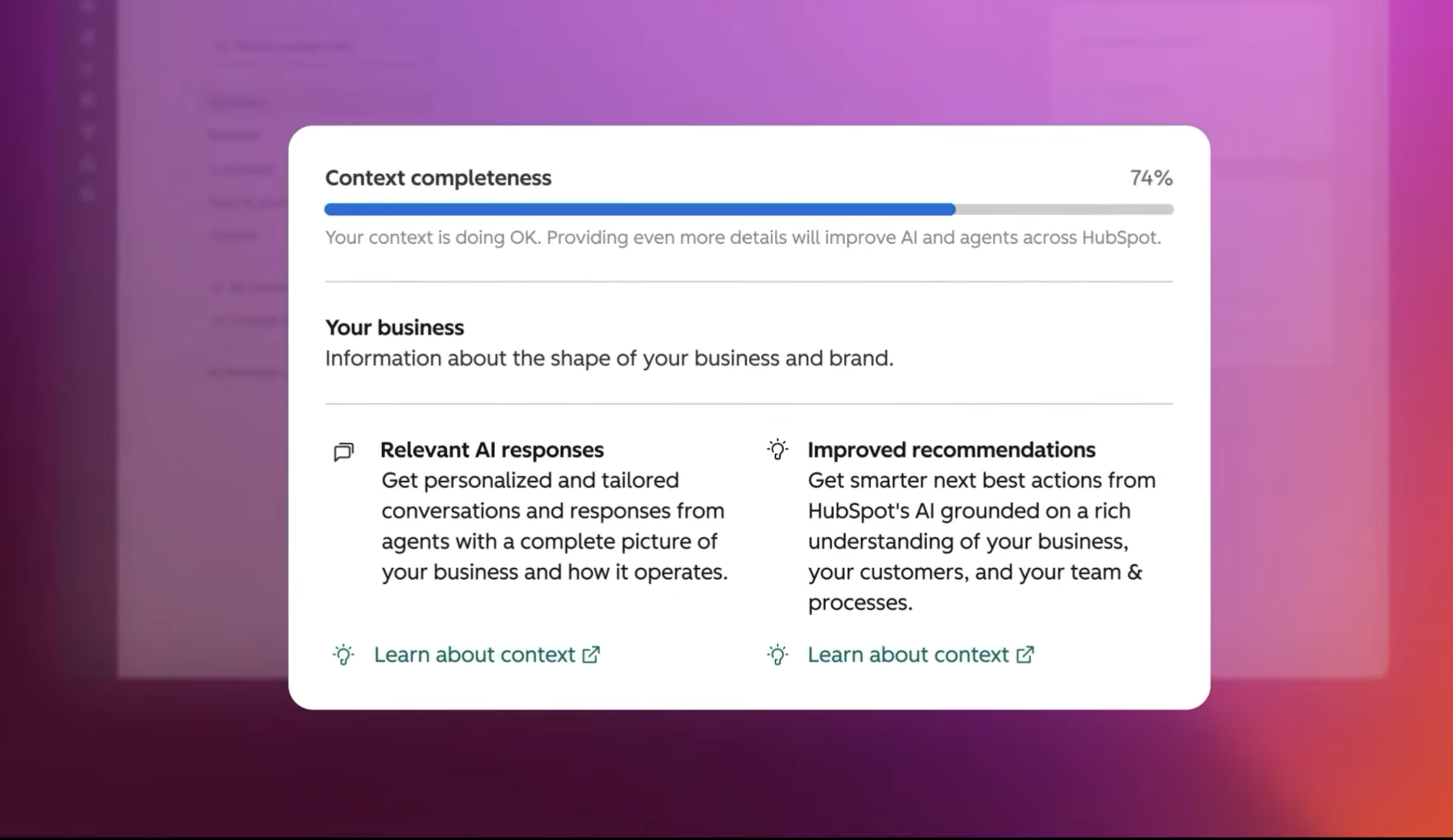
HubSpot has also introduced Context Home, where organisations can manage more of what HubSpot understands about their business, customers and teams.
For anyone working in RevOps, the ingredients are familiar: ICP, lifecycle stages, qualification criteria, lead sources, positioning, sales process, customer segments, ownership rules, permissions and handoffs.
We already spend a lot of time defining those things during implementations. HubSpot now wants AI to use them directly.
Source: HubSpot
That makes getting them right even more important. A vague ICP gives the Prospecting Agent vague criteria. Generic positioning gives Content Agent generic material to work from. If Sales and Marketing disagree about what an MQL means, AI inherits the same ambiguity. This is where AI implementation and RevOps start becoming much more closely connected.
Context Home gives that information somewhere to live, but the real work is deciding what the business context should actually be. That is a business architecture problem, and I think it will become a much bigger part of HubSpot implementations.
Breeze Assistant is becoming the interface for getting work done
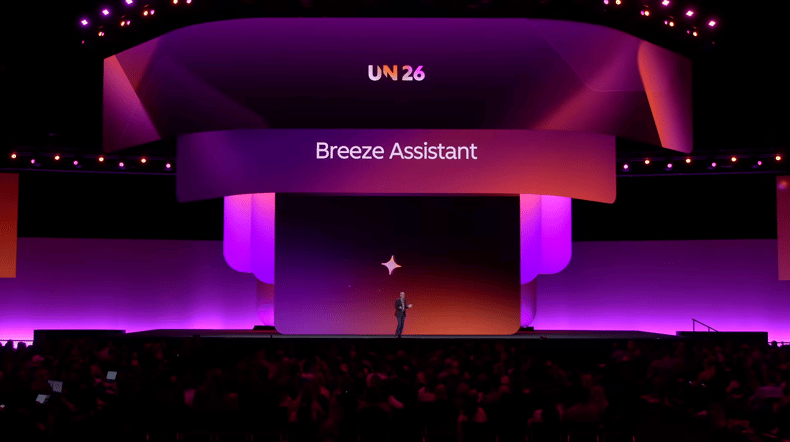
Breeze Assistant is also becoming much easier to understand as a product.
The direction now is for Breeze to sit between the user, HubSpot's context and the different agents or capabilities underneath it.
A user might ask Breeze to research an account, plan a campaign, explain what is happening with a deal, create an asset or identify customers showing signs of churn. Breeze can then work with the relevant information and tools rather than expecting the user to know which individual AI feature they need.
Source: HubSpot
It can also connect with external applications, operate inside Gmail, run scheduled prompts and use custom agents created by the organisation.
This feels closer to how people actually want to use AI at work.
Most users do not want to learn an expanding catalogue of AI features. They want to describe the job they need done and let the system coordinate more of what happens next.
Agent Builder opens up the processes HubSpot could never build for you
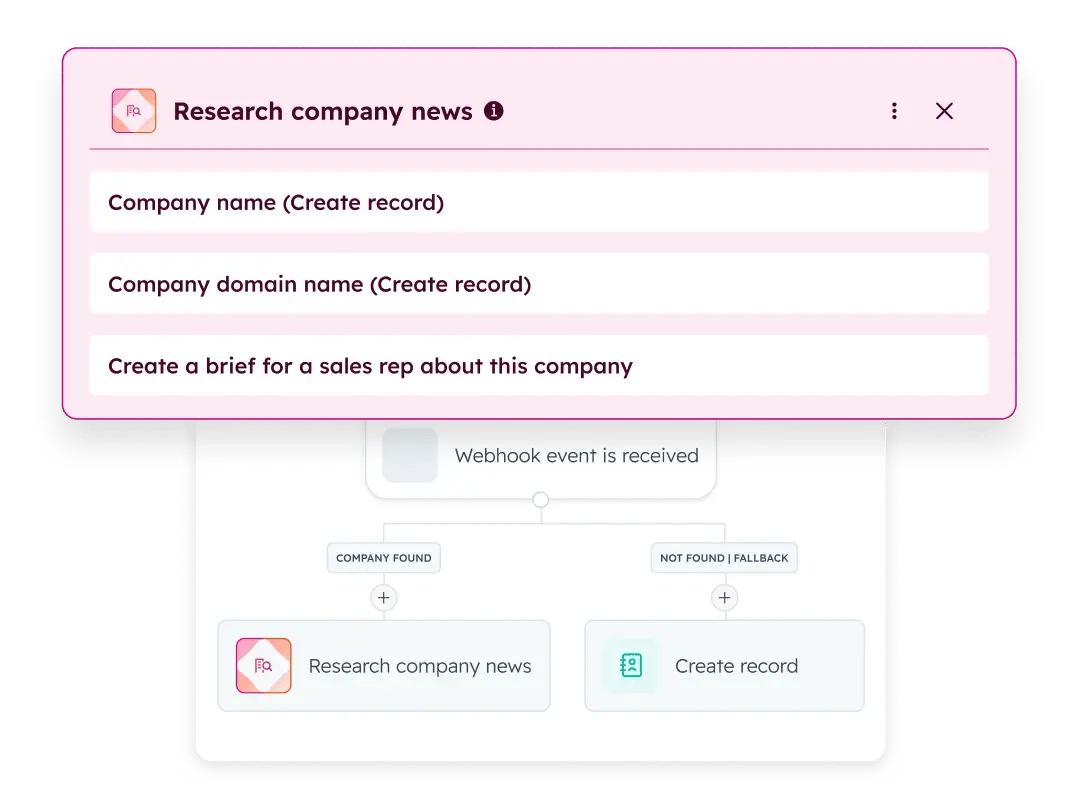
Agent Builder is one of the releases with the most long-term potential because it allows companies to create agents around processes specific to their business.
That could mean analysing closed-lost deals, evaluating prospects against an ICP, investigating stalled opportunities, preparing a pipeline review or acting when a particular combination of customer signals appears.
Those are exactly the kinds of use cases where customisation matters.
Source: HubSpot
It also creates a governance challenge.
We have seen HubSpot portals with hundreds of workflows where logic overlaps, ownership is unclear, and nobody is entirely sure whether an automation created four years ago should still be running. Agents give teams even more power, so the architecture around them needs to be deliberate from the beginning.
We are already thinking about questions such as who owns the agent, what process it supports, what it can access and change, where a human should approve an action, and how the agent is tested and reviewed over time.
Agent governance is likely to become a normal part of HubSpot governance.
Marketing Studio could connect work that currently happens in pieces
Marketing received some of the most visible releases at Spotlight, including Marketing Studio, Campaign Agent, Content Agent and Nurture Agent.
The part I find most useful is the attempt to connect the campaign process.
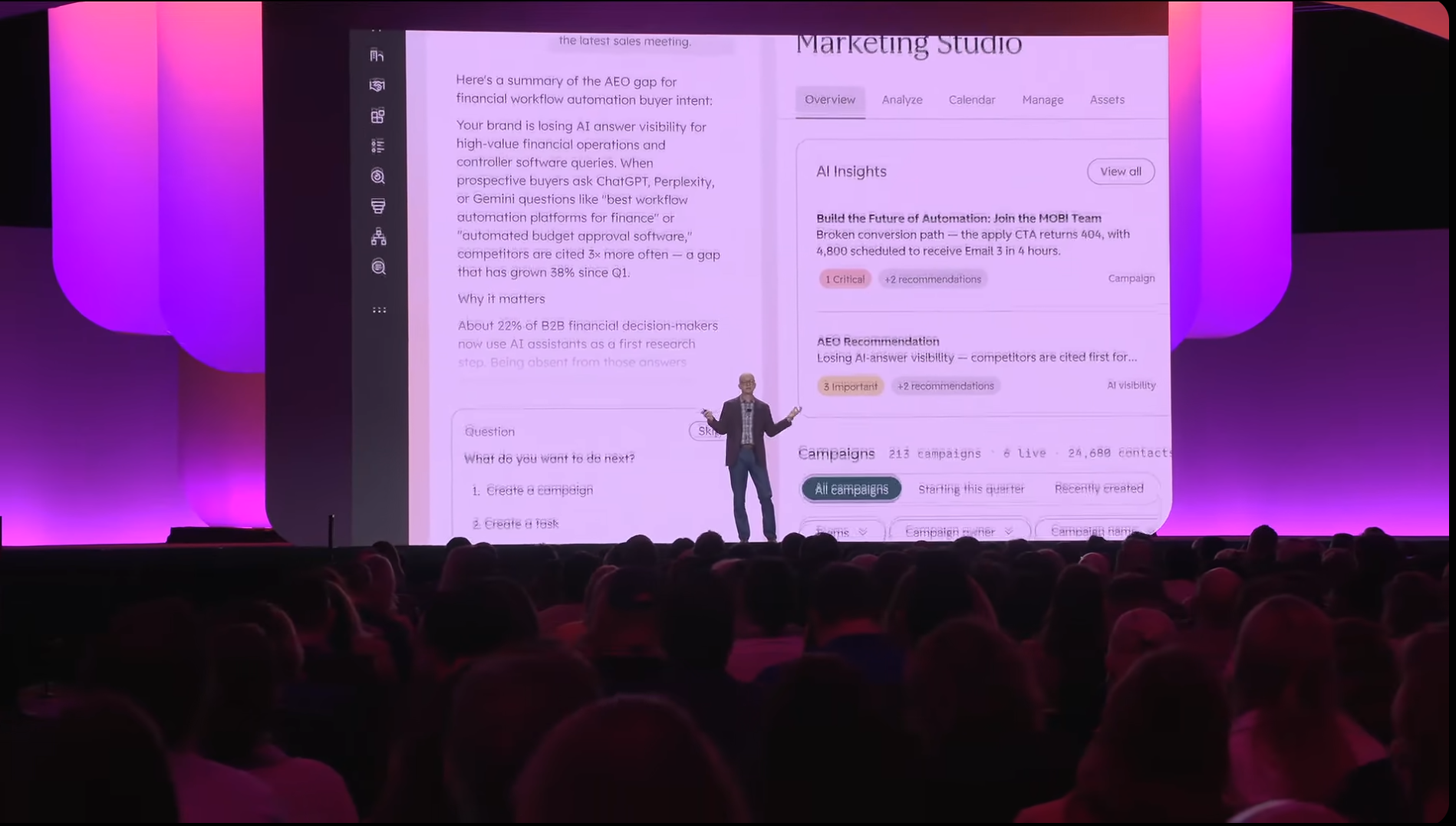
Marketing teams regularly move between strategy documents, briefs, content tools, CRM data, automation, approvals and reporting. Marketing Studio brings more of that together.
Campaign Agent can help translate an objective into a campaign plan. Content Agent can create content aligned to audience, brand, and positioning context. Nurture Agent can use CRM and engagement information to personalise follow-up more deeply.
Source: HubSpot
We already have plenty of AI tools that can write another email or blog post. The more valuable opportunity is connecting the campaign objective, audience, content, automation and performance in one operating environment.
If Marketing Studio reduces the friction between planning and execution, it could become genuinely useful.
ChatGPT Ads is one to watch
HubSpot has also introduced a ChatGPT Ads integration in public beta.
This is worth watching because the way people discover products and companies is changing quickly.
HubSpot has already been developing AEO capabilities around visibility in AI-generated answers. Paid acquisition is now beginning to enter some of those same environments. That creates the beginnings of a connected journey between AI discovery, paid visibility, CRM attribution, pipeline and revenue.
We are still early in that shift, but marketers should be paying attention to how quickly AI environments develop into both discovery and advertising channels.
Sales gets some very practical AI improvements
Some of the Sales releases are useful precisely because they deal with ordinary friction.
Deal Progression analyses calls, meetings and emails, surfaces recommended record updates, identifies next actions and helps prepare follow-up.
That matters because sales conversations contain a lot of information that never makes it cleanly back into the CRM. Reducing that gap keeps the deal record more useful for the salesperson, the wider team and the AI working around it.
Prospecting Agent continues to develop at the top of the funnel by monitoring buying signals, evaluating accounts against the ICP, identifying contacts and helping prepare outreach.
We have been working with Prospecting Agent ourselves and through the Dublin HubSpot User Group, and the setup behind it makes a significant difference.
A strong ICP gives the agent something useful to operationalise. A loose collection of industries, company sizes and job titles gives it very little.
That same principle will apply across many of HubSpot's new agents.
Revenue Hub is becoming more interesting
HubSpot is also extending further into the commercial process after the deal closes.
Revenue Agent can support collections by following up on outstanding invoices and adjusting communication as the conversation develops.
This area deserves attention because the CRM conversation has historically centred heavily on Marketing, Sales and Service, while there is an entire operational journey between winning the customer and collecting the revenue.
For companies already trying to connect HubSpot with quoting, invoicing, payments and finance systems, HubSpot expanding further into this part of the lifecycle could be significant.
Revenue Hub also makes HubSpot increasingly relevant to operations outside the traditional front-office CRM functions.
Customer Agent is becoming a more serious service layer
Customer Agent was already one of HubSpot's strongest AI propositions before UNBOUND.
The Fall updates make it more operationally mature. It can work across chat, email, social and voice, while HubSpot is also improving the controls around how teams test, deploy and manage it.
Teams can test the agent against real customer questions, define handoff rules, target particular audiences, create knowledge from resolved tickets and inspect more of the information behind its responses. Those capabilities matter because customer-service AI must handle edge cases as well as straightforward questions.
Teams need to decide when the agent should answer, when it should escalate, what information the human needs during the handoff, how it identifies knowledge gaps, and how the system improves over time.
Seeing HubSpot invest in those areas makes Customer Agent much more credible as part of a real service operation. The voice capability also opens up a much broader range of customer interactions. The live Customer Agent call at UNBOUND made that direction particularly tangible.
Watch the live demo:
HubSpot Customer Agent Voice Live Demo
HubSpot's open-platform direction may be one of the most important shifts
HubSpot is also becoming more open in how it thinks about AI.
People are going to work across several AI environments. Our customers are already using different combinations of HubSpot, ChatGPT, Claude, Gemini and specialist platforms across their organisations.
HubSpot appears to be designing for that reality.
Breeze can connect with external tools, the connector ecosystem is expanding, and HubSpot's broader platform strategy includes APIs and MCP, so other AI environments can access HubSpot data and capabilities.
This could become strategically important. HubSpot can provide the trusted customer, business and process context underneath the different interfaces teams choose to use.
That aligns closely with how we are thinking about our own work at Cat Media.
HubSpot, data and AI need to be designed together.
A company can have excellent AI tools and still struggle because the data is fragmented, processes are unclear, or the AI cannot access enough business context to be useful.
The architecture connecting those layers is becoming part of the implementation itself.
Where would we start?
The right starting point will depend heavily on the condition of the existing portal. For most customers, I would start with the CRM foundation. Review lifecycle stages, pipelines, ICP, data quality, permissions, ownership, key processes and the information you expect AI to understand.
Then identify where information is regularly being lost. Maybe meetings are happening without the CRM being updated. Deals are becoming stale. Customer information is trapped in emails. Sales spends too much time manually maintaining records. Those areas are strong candidates for the self-updating CRM and Deal Progression.
From there, choose one AI use case tied to a measurable problem. For one business, that might be Prospecting Agent. For another, it could be Customer Agent, campaign creation, deal progression or collections.
Give that use case an owner, define success, put appropriate governance around it and measure what changes. Then expand from evidence. That is the approach we will be taking with customers.
What Fall Spotlight tells us about where HubSpot is heading
Looking at the release as a whole, I understand why HubSpot is describing Fall Spotlight 2026 as foundational. The individual pieces increasingly work as one architecture.
The CRM captures more of what happens. Context Home helps define what HubSpot should understand about the business. Breeze gives users a simpler interface for getting work done. HubSpot provides specialised agents for common GTM processes. Agent Builder opens up company-specific use cases. The wider platform allows those capabilities to work across more of the tools teams already use.
Important questions remain around governance, AI credits, permissions, data quality, adoption, and how reliably these capabilities perform in complex real-world portals. That is where the real test starts.
Six months from now, the meaningful measure of Fall Spotlight will be much more practical. Is the CRM cleaner? Are teams spending less time on administration? Are salespeople getting better information? Are marketers creating better campaigns? Are service teams resolving issues more effectively? Are agents making good decisions? Can the business point to a measurable improvement?
If those answers start becoming yes, the 134 product updates will have done something much more valuable than expand the feature list.
They will have changed how the business operates.
Explore HubSpot Fall Spotlight 2026
HubSpot's official Fall Spotlight experience includes the complete release library, product demos and availability details.
Explore HubSpot Fall Spotlight 2026 →
For the full Spotlight keynote, including Yamini Rangan's Outcomes Era vision, Growth Context, the evolution from INBOUND to UNBOUND and the product demonstrations, explore our UNBOUND Intelligence HubSpot Spotlight coverage.
Explore HubSpot Spotlight and the Outcomes Era →
For our broader takeaways from UNBOUND across AI, GTM, trust, discovery, context and strategic foresight:
Read HubSpot UNBOUND 2026 | 8 Takeaways on AI, GTM and Growth →