News of critical PHP vulnerabilities tends to trigger the same question for busy WordPress site owners: “Am I exposed, and what do I need to do today?” This update walks through what happened, what we’ve already done on Cat Media Space, and what still needs your attention.
PHP security update: what Cat Media Space has already done
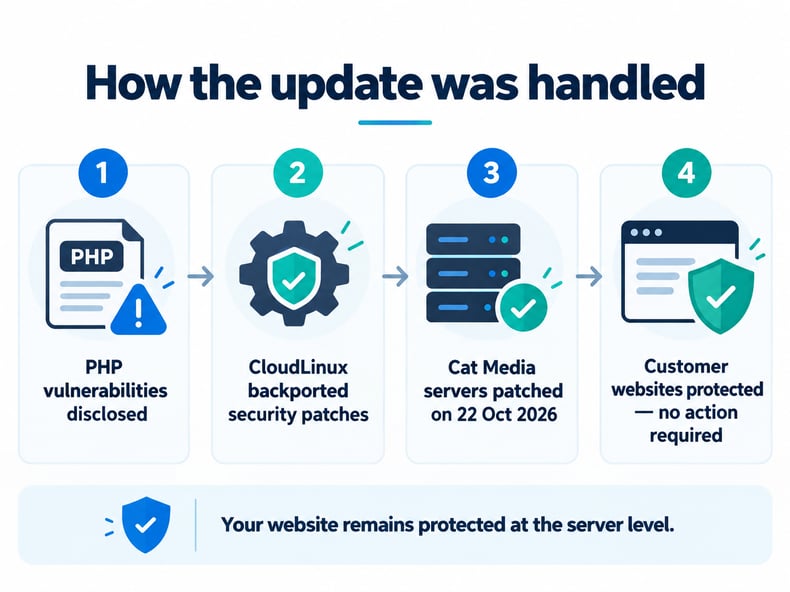
These PHP security vulnerabilities have already been patched on Cat Media Space servers, so your WordPress site is protected and you don’t need to change anything. We applied CloudLinux updates on 22 October 2026, and your existing PHP version remains supported through backported fixes and ongoing monitoring.
Behind the scenes, our hosting infrastructure runs on CloudLinux, which provides hardened, extended-support builds of PHP. As soon as the official security fixes for CVE-2026-109618 and CVE-2026-109619 were released on 21 October 2026, we scheduled and completed patching across Cat Media Space the following day. That work happened at the server layer, not inside your WordPress dashboard.
Crucially, this response was designed to be low-friction for you. There was no need to log in, switch PHP versions, or install an emergency plugin. Our team handled the rollout centrally and has continued monitoring for performance or stability issues since, so your focus can stay on content and customers rather than emergency maintenance.
What happened: understanding CVE-2026-109618 and CVE-2026-109619
On 21 October 2026, the PHP team issued a security advisory describing two critical remote code execution bugs: CVE-2026-109618 and CVE-2026-109619. Both were rated 9.2 (Critical) under CVSS v4.0 and affected all PHP installations serving web requests, including those behind WordPress and other popular CMS platforms.
In practical terms, these vulnerabilities created rare situations where an attacker could potentially run unauthorised code on a server before your application logic even loaded. The advisory notes that the risk is highest for certain configurations, such as Apache with mod_php, but the safest posture for any environment is to apply the patched PHP versions (PHP security advisory, 21 Oct 2026).
This is why we treat upstream PHP advisories as infrastructure events, not “maybe later” tasks. PHP powers around 70% of websites globally, including most WordPress sites, so widely exploitable vulnerabilities quickly become part of the automated scanning playbook. Fast, centralised patching is the most reliable way to reduce that window of opportunity.
How backported PHP patches protect your existing WordPress stack
One detail that often confuses hosting customers is how security fixes arrive without a big visible version jump. CloudLinux uses a process called backporting: taking the upstream mitigation for an issue like CVE-2026-109618 and CVE-2026-109619 and applying it to the PHP branches that customers are actually running in production.
Instead of forcing every site to jump to the latest major PHP release overnight, CloudLinux maintains hardened builds for older, widely used versions. For example, while the upstream fixes landed in PHP 8.5.12, 8.4.27, 8.3.36 and 8.2.35, CloudLinux can ship equivalent patches to compatible 7.x and 8.x builds used on shared hosting. Their own guidance on these CVEs emphasises rapid rollout and compatibility (CloudLinux CVE response).
For you, that means your existing WordPress stack — themes, plugins, custom code — keeps running on the PHP branch it was tested on, while still benefiting from the latest security hardening. It reflects our kaizen mindset: small, continuous improvements to the platform, without forcing disruptive rebuilds every time a new advisory lands.
Why your PHP version number may not change (and why that’s OK)
After reading about a critical vulnerability, the first instinct is often to check the PHP version in cPanel or a WordPress plugin. When the number you see there doesn’t match the version listed on PHP.net, it’s natural to wonder whether the patch has actually been applied.
With CloudLinux-style backporting, that version display is only part of the story. The underlying package can include the latest security fixes even when the reported version string looks unchanged. For example, your control panel might show PHP 7.4.x while the underlying CloudLinux package already contains the mitigations backported from the upstream 8.x releases and related pull requests described on php.git-pulls.
The key signal, in this case, is not the exact minor number you see in the UI but whether your hosting provider tracks and applies these security advisories promptly. On Cat Media Space, that work is handled for you at the OS and PHP package layer, and there is no requirement for you to manually switch PHP versions in response to these specific CVEs.
What you should still do to keep your WordPress site secure
While you don’t need to take action for CVE-2026-109618 and CVE-2026-109619 specifically, there are still important security habits that sit firmly in your court. Server-level patching closes one class of risk; application-level hygiene closes many others.
At a minimum, we recommend keeping WordPress core, themes and plugins up to date, ideally with automatic updates enabled for trusted components. A quarterly review to remove unused plugins and themes can meaningfully reduce your attack surface — every deactivated but installed plugin is still code that could contain a vulnerability.
It is also worth confirming that your admin users have strong, unique passwords and that two-factor authentication is enforced wherever possible. A recent review of compromised WordPress sites across multiple providers continues to show weak or reused credentials as a leading vector, even when the underlying platform is fully patched. Platform security plus disciplined admin practices is what keeps real-world portals resilient.
How Cat Media approaches hosting security beyond this incident
Our goal with Cat Media Space is to absorb as much of the operational security burden as we can without taking meaningful control away from you. That means watching upstream feeds like PHP.net’s security advisories, CloudLinux bulletins and WordPress ecosystem alerts, then translating them into concrete actions on our infrastructure.
When a critical issue appears, we prioritise a response that is fast, reversible and low-friction for customers. In this case, that meant patching on 22 October 2026, validating performance, and communicating clearly that no customer-side intervention was needed. The same approach guides how we handle kernel updates, web server hardening, and other platform changes that underpin your sites.
Security is not a one-off campaign; it is continuous improvement. We’ll keep refining our processes, monitoring for emerging threats, and sharing practical guidance when something genuinely needs your attention. If you or your team want to discuss the specifics of your WordPress hosting, you can reach us any time at support@catmedia.ie.